As part of your role, there may well be points where you, as the recognised expert on a particular area, need to pass on your knowledge to other members of your team, who will then be able to train users in the same area – you will be “training the trainer”.
What is ‘Train the Trainer’ and why is it important?
The Overall Impression Research has shown that as much as 55% of the impression we make is through our body language, 38% is through our tone of voice, and only 7% is through the actual words we use.
Train the trainer is a course which can help you improve your presentation skills. It has theory and involves a practical element where you carry out a brief presentation.
It makes you consider your learning style, facilitation skills, training design principles, your communication capabilities, emotional intelligence, listening skills and the type of leadership which may fit comfortably with you.
Train the trainer also addresses a number of other areas:
- Team building
- Training design principles
- Visualisation
- Learning space design
- Classroom management
- Group facilitation, interaction and group dynamics
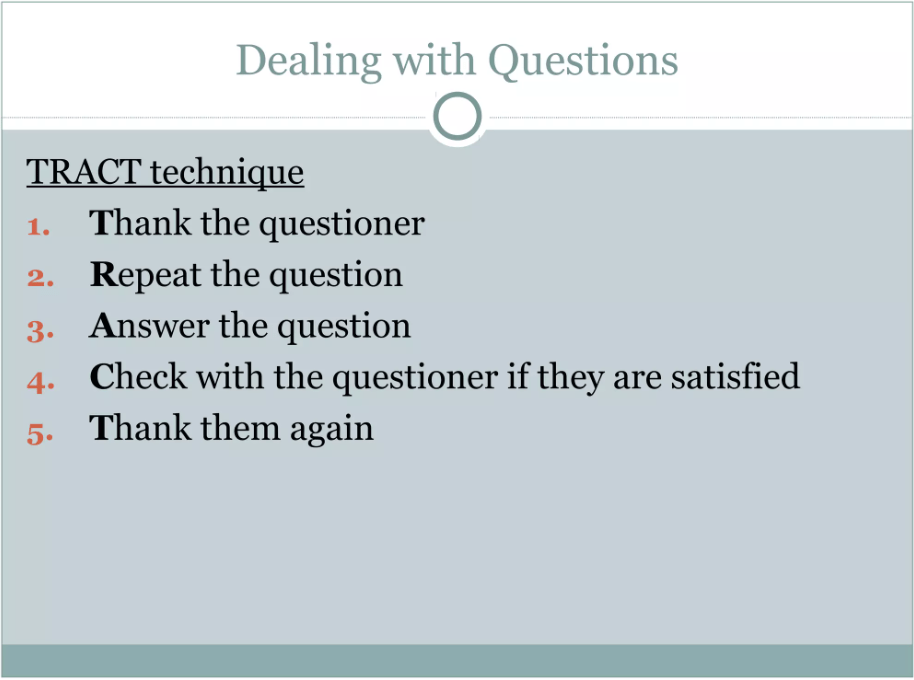
As part of this, you will learn various tactics to help with the training of others, such as TRACT – this is an acronym intended to give you steps to follow when it comes to answering questions during a session.
K. Jagad
Ultimately, you will be basing your session around SMART objectives, with other key tools to help aid in ensuring your audience gets what you’re aiming to tell them.
- You will confirm your SMART objective, ensuring it relates to both topic and audience
- The 3 tells:
- Tell them what you’re going to tell them
- Tell them in detail
- Tell them what you’ve told them

Source: Project Management
- 4Ps for pitching a proposal – position, problem, possibilities, proposal
- How much content and detail? Remember ‘less is more’. Send more detailed information in advance or after your presentation
- A pow and a wow. Include a POW to grab attention near the beginning; a WOW at the end, finishing with a flourish Start – ‘POW’! Introduction Key Areas 1,2,3 Conclusion/Summary Questions Final thought – ‘WOW’!
- With attention to the 4Ps – pitch, pace, pause, pronunciation
Creating and delivering a presentation
Creating a presentation
When creating your presentation, there are a number of models that you can follow, but ultimately each of these will have a number of standard steps:
- Plan and Prepare – develop a lesson plan that covers the main elements of your session, which you can use to help prepare the slides you will be using.
- Create a structure – create a basic structure containing the elements you will be using in the presentation, which is where you would use a tool like the “3 Tells”.
- Organise your content – bring together all of the resources you want to include in the slides you will use – these can be images and videos, case studies and examples.
- Design the slides – pull everything together and design the slides you will be using.
Delivering a presentation
There are two major ways to deliver your session – in-person or online. There will be areas to consider in both, depending on how you are delivering your session:
- If you’re delivering in person as part of a group training session:
- Practice talking to a group, and practice with the slides to help support your activities.
- Keep interacting – ask your attendees questions, and get them to ask you questions.
- If you are delivering the session virtually:
- Ensure that you are familiar with the streaming platform.
- Make sure you have the equipment you need – camera, microphone (if required) etc.
- Ensure you have invited everyone to the session.
How to Create and Deliver Training Presentations That Make an Impact
Source: SlideModel.com
What can we do?
Sign up for a train the trainer course. Quite often the course lasts more than one day so put time aside to get the full benefit from the course.
In preparation possibly consider finding a mentor, someone who could coach you and consequently look to improve your own coaching skills. Look to improve your assertiveness, decision making, influencing, problem solving, working through change and negotiating. Undergo a formal test such as the Honey and Mumford to work out your learning style, in order to make sure you know the best way for you to learn, but also to see how best to relate to the learning styles of other people.

Source: Honey and Mumford Learning Styles – A simple picture
A. Howes
What do I need to know, and where can I learn more?
Look out for train the trainer courses, as well as coaching and mentoring courses, and sign up to them where possible. You will often find courses being advertised on JISC mailing lists, as well as on the lists of events posted by CILIP.
Other resources that may be of use include:
- Online
- The Handbook of Communication Skills by Owen Hargie (via academia.edu)
- Formative Assessment and Self-Regulated Learning: A Model and Seven Principles of Good Feedback Practice by David Nicol and Debra Macfarlane-Dick
- Books
- “Talk Like TED: The 9 Public Speaking Secrets of the World’s Top Minds” – Carmine Gallo
- “Presentation Zen: Simple Ideas on Presentation Design and Delivery” – Garr Reynolds
- TED talks
- Amy Cuddy –”Your body language may shape who you are”
- Megan Washington – “Why I live in mortal dread of public speaking“
- Video Clips
- Taylor Mali, poet and educator – “Totally, like, whatever, you know”
- Malala Yousafzai’s Nobel Peace Price Acceptance Speech
Who can I contact?
Firstly contact your regional team to find out whom they usually employ to carry out Train the Trainer. If they do not have someone in place, you could then approach individual trainers.
Possible trainers and contacts:
- Lisa Jeskins – Physical train the trainer
- Diane Edwards – Virtual train the trainer
- Caroline Doherty – coach supervisor and facilitator
- Jo Walley – coach – Coaching theory and techniques, mentoring
- Amanda Stearn – Culture Change, Coaching & Leadership Development Specialist
Page last reviewed: 25 June 2025
Next review due: 25 June 2027
 Health Libraries Group