Keira O’Sullivan, Reading is Caring Co-ordinator, Scottish Book Trust
Contact: readingiscaring@scottishbooktrust.com
Studies have shown that shared reading has many positive impacts; on cognition, health and wellbeing, sense of self, and connection and relationships. A 14-year longitudinal study from (Chang, Wu, and Hsuing, 2020) showed that reading activity prevents long-term decline in cognitive function in older people. This year, Milani et al (2025) found that shared reading also makes positive changes to the happiness and resilience of older adults – and in 2019 significant effects were found on people living with Alzheimer’s using shared reading in particular (Bartolucci and Battini, 2019). Personalising this shared reading ensures that we’re accessing the important emotional memories for the person you care for, and they’re left with feelings of happiness, reassurance or relaxation.
Scottish Book Trust’s Reading is Caring has now completed its fifth year, with an independent evaluation published on our website. Below, we share some of the impacts of the Reading is Caring approach, and hope that you are able to share information about the training with those you feel would benefit.
For one man living with dementia, he often felt anxious and disorientated in the mornings. He was on edge, which made him frustrated and short-tempered with his wife, who was trying to make sure he ate his breakfast and had something peaceful to do afterwards. Mornings were hard for both of them and often their frustration escalated into bad moods. After completing the Reading is Caring training, she brought a short article, set during her husband’s childhood years, to the breakfast table and read it aloud when he had finished eating. His eyes lit up. He had had an experience just like the one in the article, playing with his brother on the land behind their house. She had never heard this before. After their reading, she not only felt that she’d got a little part of her husband back – sitting at the breakfast table, sharing a conversation – but now, she was even learning new things about him. After talking about the experiences in the article and his newly recovered memories, the man went to the living room and put on some music that reminded him of being younger and whistled along to it. He felt more secure with his wife and laughed with her as he took his medication. The day, although still complicated by dementia, seemed brighter for them both.
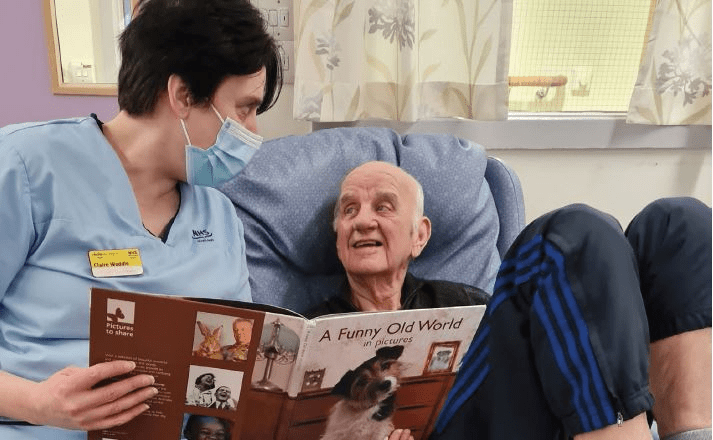
Reading is Caring is an established, free course that supports Care Partners to create personalised shared reading experiences specifically designed for the individual they are caring for who is living with dementia. We strive to ensure Reading is Caring is accessible for everyone. There are no charges for attending, our calendars are flexible, and our trainers are attentive and thoughtful. Through a half-day online workshop, we support Care Partners to tailor the reading they do to the specific needs, circumstances and interests of person they care for. In a small group, or one-to-one, we guide the participants through environmental considerations, communication adaptations, and personalised life story work. The training is available to anyone who has a relationship with someone who is living with dementia; whether a professional Care Partner, medical staff, a family member or friend. We support you to ensure that the reading you do is tailored to the circumstances of your relationship, whether that’s a short piece to read while on the move or a scheduled session of shared reading.
Reading is Caring’s independent evaluation shows that when using the approach, Care Partners see these impacts manifest in their day-to-day practice.
Care Partners shared their experiences of their connection deepening. ‘For example, non-verbal individuals joining in, unexpected memories surfacing, and new opportunities for family members (including different generations) to engage meaningfully with the person living with dementia.’ People living with dementia who engage with Reading is Caring often have a renewed sense of self. The report listed examples where confidence has been built and Reading is Caring has offered opportunities for meaningful choice, which in turn has fostered a greater sense of self and independence for the person living with dementia. In terms of health and wellbeing, Care Partners reported using shared reading to facilitate medical recommendations, for example a patient staying still and raising their feet and seeing demonstrable reductions in anxiety.
‘My mum […] was less angry and more like ‘her old self’. She was reluctant to begin the shared reading but once we began it really made a difference, and she has talked about it long after we have finished.’
With all the positive impacts that come with shared reading, the evaluation report shows benefits for the Care Partner too. Family Care Partners shared that they learned practical shared reading techniques, gained insights into dementia and felt better equipped to communicate, connect and cope with certain scenarios on a day-to-day basis. In a time that is often stressful and upsetting, the Reading is Caring approach made ‘life easier’ and they feel helpful, now, rather than helpless.
‘I feel really positive. I feel hopeful.
‘I get in the car, and I feel happy. I actually feel happy. Doing it with mum, I feel close to my Mum again. We share that mother-daughter bond.’
Professional Care Partners reported that undertaking the training significantly boosted their confidence, and they found the Reading is Caring approach useful as a way to be ‘present’ with the people they care for, resulting in more meaningful engagement. In workplaces where staff were trained, morale was boosted and staff felt more valued.
Participants often comment that they wish they had known about Reading is Caring earlier, and the recommendation of someone they trust is always most supportive. If you have any questions, or if you would like any information materials to share, to sign-up yourself or refer a contact, you can contact us at readingiscaring@scottishbooktrust.com.
 Health Libraries Group