Knowledge Management, also referred to as knowledge mobilisation or knowledge sharing, is a term used to refer to the different methods through which an organisation creates, shares, uses and manages information as a means of using it to achieve its own organisation objectives.
What is Knowledge Management and why is it important?
The purpose of the Knowledge Management process is to share perspectives, ideas, experience and information; to ensure that these are available in the right place at the right time to enable informed decisions; and to improve efficiency by reducing the need to rediscover knowledge.
To achieve a constant flow of information, continuous transfer of knowledge, and effective sharing of experience, an organization has to focus on four pillars:
- People
- Platforms
- Processes
- Culture
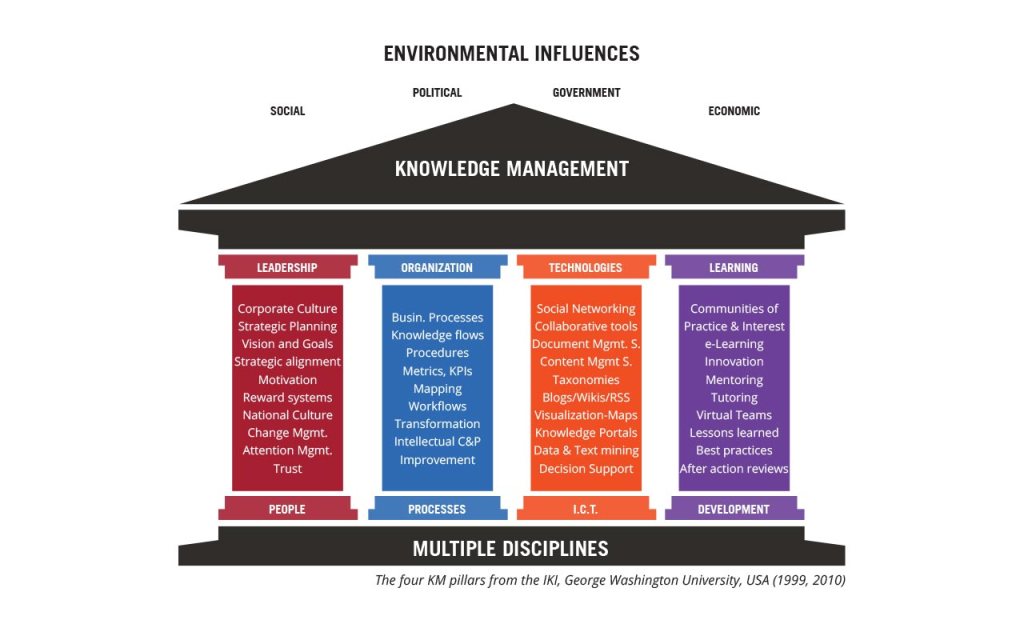
Source: Knowledge Management, Bangkok University
Although Knowledge Management is an important aspect of maintaining and retaining the knowledge gained within an organisation, it can be a challenge in ensuring people are engaged enough with the process to ensure it is successful:
Knowledge Management Challenges and Benefits
Challenges
- Lack of employee motivation
- Technology overkill
- Making sure knowledge contributions are accurately measured
- Keeping systems secure
- Instilling knowledge accuracy
- Convincing senior leaders to provide support and funding
- Making search easy
- Rewarding active contributors
Benefits
- Improve the decision-making process
- Increase customer satisfaction
- Promote innovation and cultural change
- Speed up access to knowledge and information
- Avoid redundant effort
- Accelerate customer delivery
- Stimulate growth and innovation
What can we do?
Healthcare libraries are important in helping their organisations apply and use evidence, continue to learn and build know-how. This kind of activity can help prevent mistakes, stop people reinventing the wheel and contribute to service improvement. KM activity can include creating research repositories, supporting policy work, and gathering lessons learned.
There are many different methods of implementing the KM process within organisations, ranging from fairly simple, hands-off concepts for which we, as librarians, don’t need to undertake much work, to those that are quite formal and organised. Examples of some of the methods that are used include:
- Randomised Coffee Trial – Individuals are paired at random to talk to each other, share their knowledge and experience. These help build relationships, improve communication and share knowledge and ideas.
- Knowledge Cafe – Groups come together to have conversations on various topics. These help people to solve problems, break down the silos between teams and build an organisational community.
- After Action Review – A short, facilitated session following an activity, such as a project task or training session. These are aimed at allowing teams to review the task to determine what were the strengths and how to improve on the weaknesses.
What do I need to know and where can I learn more?
The Knowledge Management Cycle is a process of transforming information into knowledge within an organization. It explains how knowledge is captured, processed, and distributed in an organization.
The Knowledge Mobilisation pages on the NHS England LKS website is a key place to go for all things KM related. There are numerous links and ideas for you to follow-up, including tools, KM stories, training resources, a self – assessment tool and community of practice. Part of this is the Knowledge Mobilisation Framework, aimed at gathering learning before, during and after an event.

Source: NHS Knowledge Mobilisation Framework
Each of the different tools listed in the framework has had an individual postcard created, which goes into more detail about what is involved.
NHS England have also provided other resources to help you on your journey into the world of Knowledge Management. Additionally, there is an e-learning programme available on e-Learning for Healthcare.
There are also links to people who can help you who have developed expertise in this area. Chris Collison is a recognised expert in KM who has also co-authored the KM Cookbook, which provides lots of insights from different organisations. The links to this are also on his website along with a link to another of his books Learning to Fly.
Look out for Knowvember, a month dedicated to KM in health libraries where libraries will offer activities to promote KM in their organisations, and other activities for library staff take place.
Who can I contact?
The Knowledge Mobilisation Community of Practice set up by NHS England’s LKS allows staff interested in Knowledge Management / Mobilisation to ask questions, share ideas and develop the knowledge base.
You can also contact the NHS England Knowledge Management team directly
Page last reviewed: 25 June 2025
Next review due: 25 June 2027
 Health Libraries Group