Victoria Harrison, Library and Knowledge Services Manager, Royal Berkshire NHS Foundation Trust and Maria Walker-Reeves, Senior Patient Experience Facilitator, Royal Berkshire NHS Foundation Trust (Photos by staff from Coley Park Primary School, reproduced with permission)
What does a librarian do?! One of my favourite bits of my job as a librarian is when we welcome our Junior Carers, as this gives us a chance to explain our role in the Trust to primary school children with an interest in health. It also gives me a chance to explain why libraries are important more generally – as one child commented, “There are lots of interesting reasons why you would go to a library”. Having a child of a similar age, I enjoy the challenge of answering their questions honestly, but at an age-appropriate level. I also get to unleash my creative side and do something a little different to tackling budget spreadsheets or coordinating staffing!

The Junior Carers Programme was developed in 2019 by the Patient Experience Team (PET) at the Royal Berkshire NHS Foundation Trust. This inspiring programme’s main focus is to engage with local school children from diverse backgrounds in Reading and expose them to educational healthcare topics and healthcare careers. The PET is now working with three schools, engaging with 36 children in total, all from Year 5 (age 9/10).
Each month, the schools will visit the hospital separately to learn and experience ‘Life in Healthcare’. The children expressed a particular interest in the Trust’s Library Services. This really delighted the PET team, who are passionate supporters of our service and who know that Libraries lay a strong foundation for lifelong learning and academic success, where reading is celebrated and encouraged.
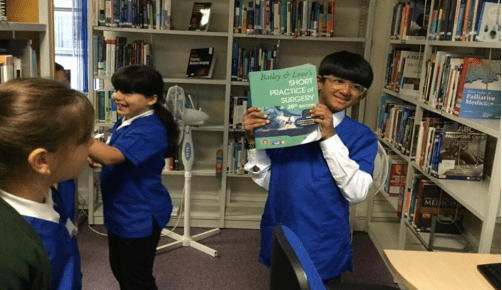
On the day, Vicky Harrison (the Library and Knowledge Service Manager) explained to the children about the Library and Knowledge Services (LKS) and how the library helps clinicians learn how to find evidence on how to treat people using the best methods and techniques. The short presentation encouraged input from the children, who were really engaged and asked lots of questions. Vicky and her colleague Sue, with support from the teachers and Maria (one of our fantastic Patient Experience Team), then provided the children with the opportunity to get involved in three interactive activities:
- Issuing and returning books on the library system, including stamping the books with the date stamp – learning about a different type of IT system and how it works
- Designing their dream library on A3 paper, thinking about the type of library and what would be needed to support the user
- Creating a paper origami bookmark with an animal face – learning that we also have a remit to help support staff wellbeing and so the children had a memento of their visit.
These activities were cheap to run, using materials that we already had in the Library, so there was minimal cost to the Trust or outlay from our budget. The children also had plenty of time to take a look around the Library, quickly finding things of interest – such as our games section and our fiction collections. The session was so successful that the children did not want to leave when their time was up – given they were going to lunch, this was some achievement!

We do not close during the visit and there is, inevitably, a little bit of disruption for the period that the children are present – and when setting up and tidying up. We are a very small site, so all children are always in sight (and sound) of one of the teachers, library staff, or patient experience team – this is mitigated by clear signage advising library users of the fact, and by advertising of the upcoming visit on our Intranet site. We also physically walk around and notify library users on the day, warning that the library may be noisier than usual. As the session is fairly brief, we’ve not had any complaints to date- some staff use it as an opportunity to take a brief break from their work, and have a coffee in the downstairs café.
The children are asked about – also included in one presentation slide – typical library etiquette as it cannot be assumed that children have visited a library before, particularly given these are children who experienced lockdown as 4–5 year-olds. The children are asked to all agree to follow these mutually agreed rules. The children themselves have been very conscious of the fact they are in a library and have been a credit to their schools.
Impact of the library and knowledge service
The children learned about the LKS and how they support the Trust and gained a greater understanding of Libraries. The session really stimulated the children: 12 children took part in this session with 66% of the children strongly agreed, and 33% agreed that the session was interesting and informative – most importantly, the visit gave a fun memory of being in a library, which hopefully left a positive impression.
Due to the success of the visit and the impact it had on the children, further visits are planned for 2025 – in addition, engagement with older children in secondary schools is also being considered. These sessions could potentially cover food literacy and awareness around medication labels, and would be more in-depth and time-consuming, but could build on the existing health literacy for schools work previously done by Royal Berkshire Hospital NHS Foundation Trust Library and Knowledge Services and Berkshire Healthcare NHS Foundation Trust Library and Knowledge Services.
 Health Libraries Group