Bridget O’Connell – Clinical Evidence Based Information Service, University Hospitals Coventry & Warwickshire
The Clinical Evidence Based Information Service (CEBIS) from University Hospitals Coventry and Warwickshire (UHCW) NHS Trust is part of the Knowledge and Library Services department. CEBIS promotes evidence-based practice, quality and patient safety and professional development at the Trust. We do this by supporting patient care, audits, new guidelines or pathways, research, service development, publications, and presentations. Our team have team members dedicated to Specialty groups and we embed into their teams to provide timely and specific support.
The CEBIS team had the opportunity to attend the International Clinical Librarian Conference (ICLC) in Leicester last year. Delegates from around the world took to the floor to share their learning and experiences and the CEBIS team had three ePosters to share. For some members of our team, it was their first experience of a Knowledge, Library, and Information conference, so we’d like to offer some of our learning and reflections from the two days.

Mandeep Heer presented an ePoster on the clinical guidelines work that we have been working through at UHCW NHS Trust using the UHCWi Management System which is all about quality improvement using Lean methodology. Mandeep reflected that:
“Conferences are most often exciting events, and it was great to attend the ICLC conference face to face after the pandemic. There was mixed audience at the conference, which offered great opportunities to network with other professionals, enhance our confidence, motivate, and develop our knowledge. All the presentations and posters were very engaging, the most interesting presentation I found was from Sophie Easey and Tricia Rey (The National Searching Guidance) as this site is a valuable resource for searches and trainers in NHS library and knowledge services. It is freely available online and I think it will remain as useful a tool for all our CEBIS specialists as it has been for me.”
Lukasz Lagojda shared his ePoster on Supporting Evidence Synthesis and Facilitating Research into Practice. He commented “It was my first non-academic conference, and I enjoyed the more relaxed atmosphere. However, I was surprised by the format of poster presentations. We are constantly reminded in academia that presenting at conferences is the best opportunity to maximise our contact with the audience. In my experience, having allocated time for the attendees to mingle and confer our ideas around each other posters works best for formal networking.”

To complete our contribution Charlotte Crutchlow and Keri Bramford-Hale talked us through an ePoster on how the diversity of background and experience contributes to service provision. They had been unsure on how this would be received, but:
“The last-minute addition of a Menti survey offered such a fantastic insight into the career paths of not just our own team, but services across the wider Knowledge, Library, and Information professional community. From flight attendant to supermarket assistant to librarian, via scientists and economists, we really are a dynamic bunch!”
The pair wished that they could have run that particular snapshot over both days to capture the full audience.
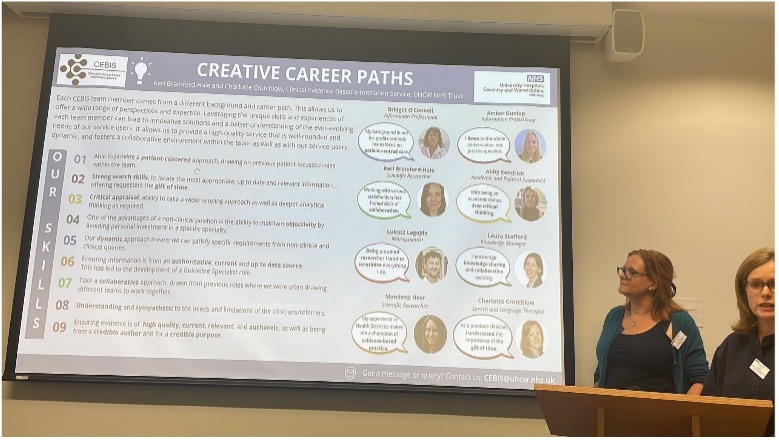
Keri said “I’ve attended scientific conferences previously, and this was an altogether different type of event. It felt less formal and more relaxed which allowed me to chat with others, and I really valued the conversations that I had. The opportunity to network meant that I had some good introductions to the wider Clinical Librarian community.”
The presentations generated lots of interest and questions and showcased the range of work that we do to supported evidence into practice at our Trust. Keri had a long chat with Alison Harte, who came from a very similar scientific background and for both the role brings along so many new skills but uses so much that they already have. Mandeep noted that when she:
“Presented my poster at the ICLC conference [I] observed that the audience were very engaged and making notes with the audience keenly asking a couple of questions. People come to me after the poster presentation to understand the guidelines process, particularly the team from Derbyshire. In the future ICLC conference, rather than presentation which are showcasing what we do, it might be more beneficial to have interactive workshops where we can learn more from each other.”
We are in the fortunate position of having a good-sized team. Bridget O’Connell was taken with the talk by Kerry Flett at Solent NHS Trust who is single-handedly running a hybrid service in multiple locations. Her creativity and energy in approach was inspiring and useful for CEBIS as we constantly work to develop new and innovative ways to engage with our clients and consider their information needs preferably before they realise what it is that they require.
Another team member Abby Kendrick reflected: “I have never been a huge fan of conferences. In my experience, (as an economist) they can be scary places, where you are your paper and no more. The ICLC had a very different atmosphere to any conference I had attended before; I met nice people and learned a few things. From the sessions and by chatting to the folks I sat with on my table, it became clear just how big a thing systematic reviews have become in the world of Information Specialist-ing. Whether this is good, bad, or somewhere in between is an open question, and one I enjoyed discussing.”
Our colleague Amber Dunlop was very interested in the presentation by Lucy Wells “Presenting evidence in clinical meetings”. She said:
“Since 2010 CEBIS has been delivering evidence to clinicians at UHCW NHS Trust. We embed within clinical teams to ensure that, where possible, the evidence provided is translated into practice. For over a decade I have attended conferences/heard discussions of how to move this way of working forward and how to attain buy-in at a management/clinical level, so from this perspective it was disappointing to hear of this as a “new” service in development. But equally it was excellent to hear that there was much less of a fight required to attend these clinical meetings and to build interest from the clinicians themselves. Lucy presented brilliant examples of introducing herself to new clinical groups and providing evidence to present at their meetings both in person and virtually to allow attendance even when she was working elsewhere. Post pandemic clinicians seem more accepting of virtual attendance and we see this as a positive in terms of providing clinical librarian services to a much wider audience where we may not be able to attend in person, making smaller CL teams more widely available without having to convince the financial powers that be to invest more in our services until we have more evidence of financial benefit from impact case studies of our work.” She stated: “I was both pleased and disappointed to see that other clinical librarians are still in the early stages of setting up outreach services aimed at delivering best available evidence at the point of care.”
Mandeep, another longstanding CEBIS member had a similar observation:
“I have been working as a CEBIS specialist for a long time and I have discovered that CEBIS is still a unique service by its size and scope. I spoke to the various team members at the conference to get general idea on what sort of services the other Trusts offers to their customers. l yet to come across anyone who provides the same service as CEBIS.”
We made some contacts at the conference that we hope will be mutually useful. An example is that as a direct result of contacts made at the conference, we joined Trip AI workshop meetings (in addition to receiving good tips on AI training). We look forward to welcoming Steve Glover and his team on a visit to our Library. These connections can only be made with the coming together of interested and engaged people given the time and space to share their interests and knowledge.

We would like to thank the organisers for pulling together such an informative and enjoyable event and look forward to meeting up with contacts at HLG2024.
 Health Libraries Group