Kerry Booth, Assistant Librarian, University Hospitals of Morecambe Bay NHS Foundation Trust
Background
In response to a number of complaints received by the Trust relating to the quality of clinician to patient communication, UHMBT Library and Knowledge Services (LKS) participated in two health literacy awareness trainer sessions provided by Health Education England. The aim was to start facilitating health literacy awareness (HLA) sessions with as many staff groups and students as possible.
Foundation Programme
As the Postgraduate Education Team already had teaching sessions running for the Foundation Year 1 (FY1) doctors, it was decided that UHMBT LKS would deliver a session to these staff members. The sessions were delivered twice a year for the FY1 doctors based at Royal Lancaster Infirmary (RLI) and Furness General Hospital (FGH). Following a break in 2020 due to the COVID-19 pandemic, the HLA session was expanded to another session on patient information; including exercises on “Teach Back” and “Chunk and Check”).
The FY1 session was reviewed and tailored to include less clinical scenarios and examples, with two ‘drop-in sessions’ being run via Teams during Health Information Week 2022. These sessions were open to all UHMBT staff and were promoted by the Strategic Lead for Inclusion & Engagement and the Patient Experience Teams. The sessions were adapted so that they could be presented via 365 Teams; adaptations included the use of Google “Jam Board” to facilitate discussion, and engaging activities to promote trainee participation.
Attendees in the face-to-face sessions enjoyed and appreciated the variety in the sessions, including the ‘codebreaker’ exercise, the opportunity to share experiences and the Dr Jargon game.
“Examples of real-life issues highlighted the issues with health literacy.”
“The opportunities to reflect on our own practice – patients often either have lots of questions or feel too nervous to ask.”
“The games are interesting. It helps us understand the perspective from a patient’s point of view.”
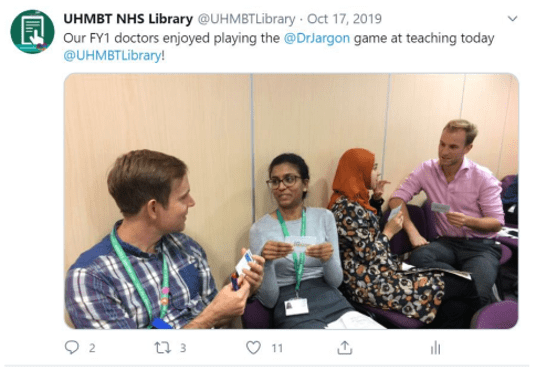
As of 2024, following a review of the Foundation Programme, it was decided to refocus the programme towards more clinical sessions. Therefore, the health literacy awareness and patient information sessions have not been a part of the programme since 2023/24 – which has had an impact on our induction and training statistics (see table).
| Year | Sessions | Attendees |
| 2019/20 | 2 | 32 |
| 2020/21 | 1 | 16 |
| 2021/22 | 2 | 15 |
| 2022/23 | 4 | 35 |
| 2023/24 | 6 | 108 |
| 2024/25 | 2 | 34 |
Health Information Week (HIW) Trolley Dash
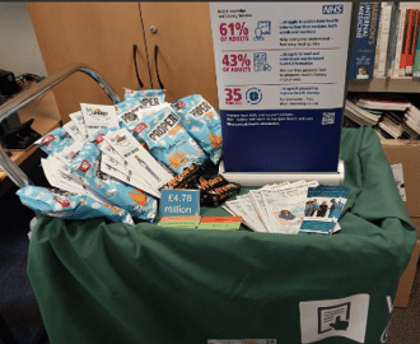
As part of HIW 2023, we decided to do a ‘trolley dash’ around our Lancaster site. We included LKS marketing materials as well as jargon cards, statistical examples of low health literacy and materials promoting the health literacy awareness and patient information sessions. Once we had loaded up our trolley, we covered around a third of the hospital departments in the hour we had allocated. We were successful in raising the profile of the LKS and have used the trolley dash idea to promote the LKS outside of HIW since that time.
Impact
The number of awareness sessions delivered by the LKS and the number of attendees to the sessions doubled from 2021/22. The figures for 2023/24 surpassed the previous year as a result of collaborating with the Patient Experience Team. However, the pausing of the preceptorship days and the focus toward more clinical sessions for the foundation programme has seen figures decreasing again for the year 2024/25.
Being involved with induction days and working with other departments and teams on health literacy awareness has enabled the LKS to be more visible to different staff groups and students. This enables the LKS to highlight to services users, or potential service users, the services provided that are beyond that of what they perceive a library to be, i.e., ‘just books.’ The impact on the LKS is that we have more users engaging with the LKS via requesting information (articles/evidence searches), making enquiries and visiting the library spaces for study or learning purposes.
Session attendees have also expressed the impact of the sessions on their own understanding, knowledge and practice. Another impact is that the sessions has also raised awareness of the patient information leaflet process. This means that attendees are aware that there is process for creating leaflets for patients; including asking the LKS for an evidence search and gathering feedback from patients.
“I will think harder when explaining – whether my words are jargon.”
“I will summarise information – let the patient ask questions.”
“I will not assume people have understood.”
“Explain more effectively – not using words that I now realise were medical jargon.”
“Patient Information Leaflets Process as this will solve some problems for me.”
Lessons Learnt
- Feedback – it is better to ask attendees for something more specific; for instance, naming one thing they found useful etc.
- Don’t be afraid to make changes whilst the sessions are taking place!
- If attendees are not engaging, try different tactics such as Slido, the Feedback Game or asking individuals to offer their views.
- Rebranding HLA as ‘Helping Patients to understand our Jargon’
Looking ahead… Health Literacy for Manchester Metropolitan University students
I have been asked to be a guest speaker in a session for postgraduate students at Manchester Metropolitan University (MMU) as part of their Introduction to Health Librarianship module in November 2024.The presentation will cover what has been done in terms of health literacy awareness at UHMBT and how the students can get involved in training delivery and other health literacy-related projects within their own organisations. This is an opportunity for us to showcase our work in relation to health literacy awareness and share learning and ideas with other professionals.
 Health Libraries Group