Daniel Park, Library & Knowledge Service Manager, The Rotherham NHS Foundation Trust
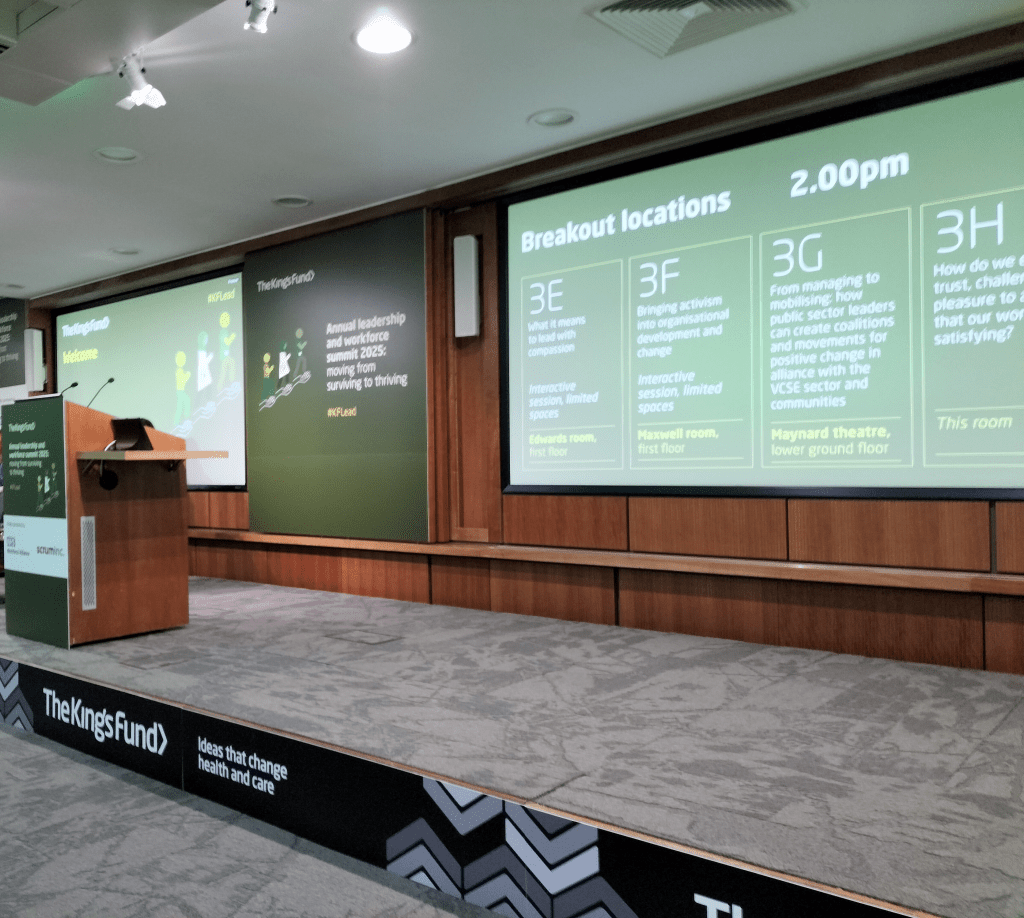
Each year, the King’s Fund holds a summit of NHS and related health leaders where nuggets of leadership and management wisdom are handed down by health executives at the highest level in the context of the issues of the day.
Maintaining a balance of learning and topicality always proves something of a challenge; one which the King’s Fund understandably struggled to achieve this year given that the Government announced the closure of NHS England only a few days prior to the summit. As such, the speech by Amanda Pritchard, Chief Executive of NHS England, was followed by questions from press representatives (The Times and the Health Service Journal) in the room.
This speech came at the end of the summit and the press didn’t say anything that delegates and speakers hadn’t already heard many times before. No-one pretended there wasn’t an elephant in the room. Even when said elephant wasn’t name-checked, there was a clear recognition that the healthcare leaders were making management decisions in the context of anxious and demoralised staff.
“Investing in staff was rather like building a kitchen extension rather than splurging on a round the world trip, in that the training ‘extension’ added value to the ‘property’ of the NHS”
Dr Navina Evans, the Chief Workforce Officer for NHS England, explained that patient and staff satisfaction was closely aligned in the health service, and that a demoralised workforce was an unproductive workforce. She hinted at the importance of managers being better trained to serve their staff, something that Amanda Pritchard picked up at the end of the day with the announcement that 22,000 managers from Bands 6 to 8a would be given the opportunity to embark on management training in the future. Kevin Fong, Professor of Public Engagement and innovation at University College London, reinforced this with an interesting analogy: saying that investing in staff was rather like building a kitchen extension rather than splurging on a round the world trip, in that the training ‘extension’ added value to the ‘property’ of the NHS.
Dr Sonya Wallbank at the King’s Fund looked to the NHS employees of the future, emphasising the need for more work placement opportunities and the assurance of a manageable work-life balance, and citing the example of a nurse who was refused leave for her wedding day, an entire year in advance, and who promptly quit the service who refused her.
Simon Newitt, another officer from the King’s Fund, suggested that work-life balance was better managed by leaders when they delegated timetabling decisions to their teams, allowing for sensible every-day choices from colleagues made in the staff room, rather than relying on strategic decisions made in the board room.
Time and again, speakers emphasised the need for common-sense solutions to prevail, and for managers to appreciate that driving staff ever faster and harder was counter-productive, when the chance to pause to gain a sense of perspective and co-operate with their peers led to far greater opportunities for effective communication and efficient working.
From a health library point of view, much of the activity envisaged looked very much like the events that we’re invited to hold during Knowvember. Ironically, as a library manager I have often opted out of these because my team was too busy, but it’s pretty clear to me that I have hitherto ignored my own elephant and fallen victim to my own warped priorities of false efficiency, when this summit made it very clear how much NHS staff benefit from networking opportunities with their peers.
Finally, Ian Henessy, Clinical director of innovation Alder Hey Children’s Hospital suggested taking non-clinical colleagues to see an operation and speak to the patients afterwards, whilst also taking surgeons to visit the IT department. It might be a step too far to send a librarian into the operating theatre, but it would certainly be a novel way of getting clinical librarianship closer to the action!
 Health Libraries Group