Kerry Booth, Assistant Librarian, University Hospitals of Morecambe Bay NHS Foundation Trust
Background
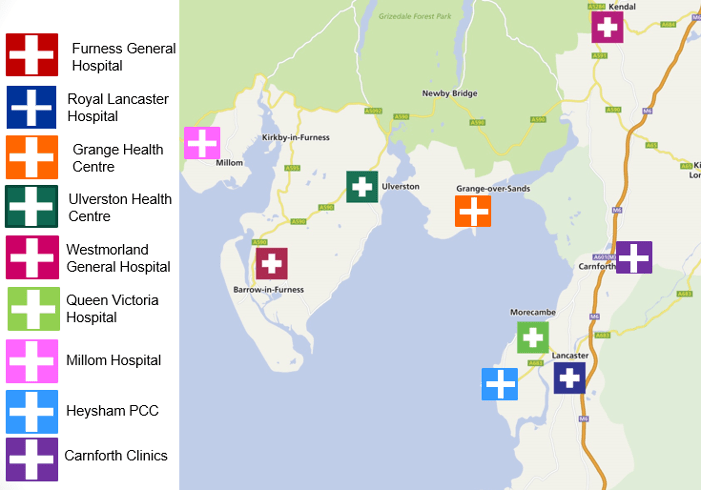
The Library and Knowledge Service (LKS) at University Hospitals of Morecambe Bay NHS Foundation Trust (UHMBT) covers a large geographical area. Beyond the three main hospital sites, Royal Lancaster Infirmary (RLI), Furness General Hospital (FGH) and Westmorland General Hospital (WGH), there are several sites where the community teams are based. It is not possible for all staff working within the community to visit the physical library spaces at RLI and FGH. However, these staff have access to all the online LKS, and it is possible to send physical books out to these staff using the Trust internal mail system.
The outreach project was introduced to fill the gap in the LKS coverage with regards to the community teams. The project was about connecting the LKS with the community-based teams and building links with them so they are aware of, and therefore, can access the LKS. The project was built on a previous ‘pop-up library’ project to improve outreach to the UHMBT community teams as part of the LKS outreach strategy. The previous ‘pop up’ libraries proved a valuable starting point which did allow community teams to touch base with the LKS, so the idea was reviewed and redeveloped. This project would focus less on a physical presence or ‘drop in’ from the library and more on how the LKS can support these teams in their roles without a physical library space and what resources they can access remotely.
Improving our outreach would allow the community teams to access the information services, resources and training the Library and Knowledge Services (LKS) provides to assist them in their job roles and help them in their learning and development.
Building blocks…starting over after COVID
A starting point was to email my contacts from the district nursing (DN) teams involved in the 2018-2020 ‘pop-up library’ project. I restarted the visits to the WGH site as this site has not had a physical library space for several years. These site visits involved mapping out the services based at WGH and doing walkarounds onsite to introduce myself and ask for the best contact for the department. Some internal enquiries also led me to some primary contacts for the other sites, such as Millom Hospital and Queen Victoria Hospital (QVH). These contacts, and those from the DN teams, received an introductory email and request for a Teams call to discuss further. This led to library induction presentations being scheduled for several of these teams during their monthly or quarterly meetings.

Some barriers were encountered at various stages of the project, such as staff having limited time due to the service pressures and a be lack of engagement from some staff. This led to a decision to focus on building stronger links with the teams that had engaged most with the LKS. These teams included the DN teams, the pharmacy team based at WGH, the Dietetics team based at QVH and Ophthalmology teams.
Mini me…in-house library collections
We formed connections with the ophthalmology team based at WGH, so, it was decided to pilot a small in-house library collection within that department. This involved asking the team for their feedback on key texts for ophthalmology and a budget was allocated for the collection. Alongside the books, information about other library services was displayed and the collection currently resides in the staff room in the department. The development of the collection had some delays, such as getting feedback for key texts and industrial action meant that a full launch was not a priority during this period. Instead, the collection was made available from the end of February 2023 with a ‘soft launch’ during the ophthalmology team meeting in April 2023. The collection is used, and books are either borrowed or browsed frequently, especially if staff and undertaking a course as part of their role or CPD.


Knowledge Management…developing current awareness bulletins
The site visits to WGH and QVC and in-person ‘check-in’ visits by the LKS with these teams led to the development of several new current awareness bulletins.
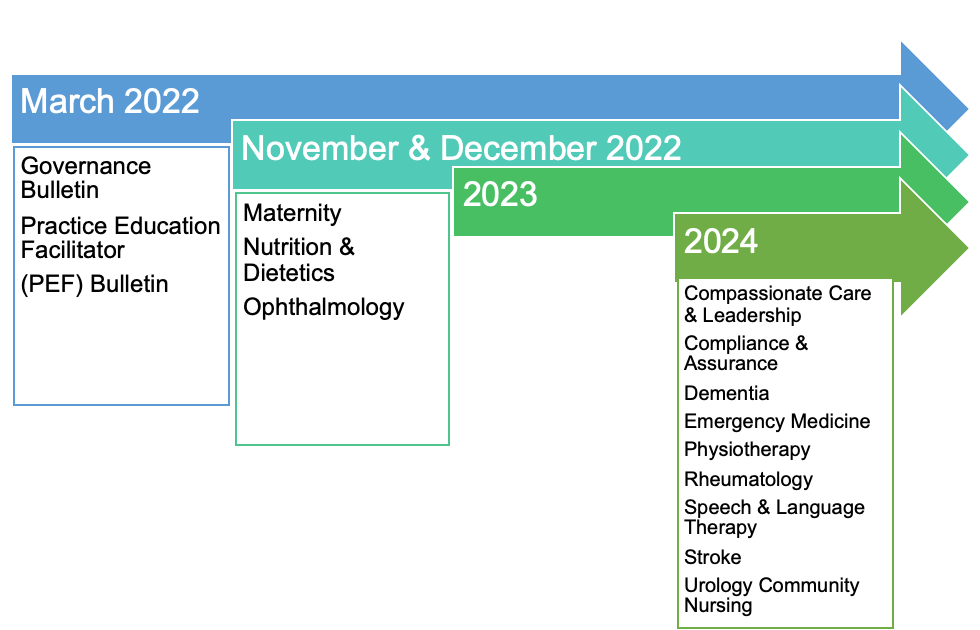
November 2024
- Total of 18 current awareness bulletins
- Further Surgery current awareness bulletins in drafting stage for publication in 2025
Brace for impact…
The outreach work, alongside more focused marketing by the LKS team, led to a general increase in the amount of work the LKS received, such as enquiries, article requests and requests or questions about literature/evidence searches. Between April – December 2022, there was a steady increase in the number of article requests (supplied from LKS stock, LIHNN or the British Library) and literature searches from February & March 2022. Literature search requests increased following LKS attendance at departmental team meetings in June, September, and October 2022. The publication and circulation of some of the new current awareness bulletins in December 2022 (Maternity), February 2023 (Ophthalmology) and June 2023 (Nutrition and Dietetics) led to an increase in article requests received by the LKS.

Purple – LKS Inductions at Team Meetings
Red – Ophthalmology audit meeting
Pink – Community Team meeting.
Light Blue – Ophthalmology Bulletin.
Orange – Nutrition & Dietetics Bulletin.
Grey – Palliative & EOL Care Bulletin.
There has been a general increased awareness of the LKS, with many commenting that they had not “known there was a library service.” Some administrative staff said that they were aware but had not “realised that they were allowed to use the library.”
LKS attendance at some on the departmental team meetings to present a library induction sometimes had an immediate impact, in that attendees got in touch with the LKS soon after the meeting. For instance, after the Team Leader Governance Briefing in June 2022, within half an hour of the meeting ending, I received a literature search request for the purposes of patient information. The requester feedback that the request came because of seeing the LKS presentation at the meeting, saying “I just listened to your talk on the TL meeting and wonder if you could assist us with sleep hygiene info to give out???”
Generating links and lists of contacts during the project has meant that the LKS has more service users to contact for marketing purposes. This may be generic marketing emails promoting the LKS (literature searching, patient information, online resources) send on a regular basis or emails to certain teams with new stock or resources that would be of specific interest to them (such as new books – see below).
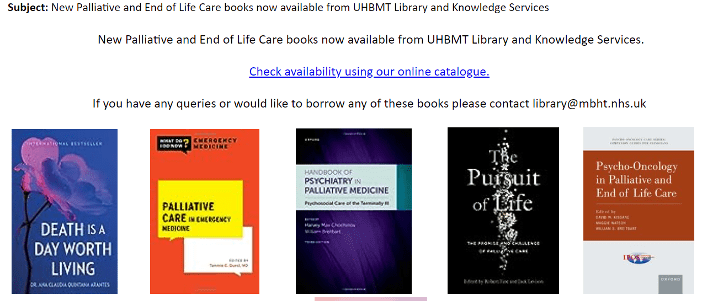
This collaborative working also means that the LKS can directly contact teams about their knowledge and information needs. Working with the Palliative and EOL care team meant that when the LKS identified a gap in the library stock in relation to Palliative and EOL care, I could approach the Team Leader Specialist Palliative Care Team (community adult nursing) and work with them on what new texts would be beneficial to the Palliative and EOL care team and what topics are current in this area etc.
Branching out further?
The LKS can continue to work closely with the Palliative and EOL Care teams on the quarterly bulletin that supports their quality improvement work. The general increased awareness within the teams based at WGH or at the community sites will result in the number of information and knowledge requests (article requests and literature/evidence searches) overall. Staff can then use this information use to support them in their roles, their continued professional development, direct patient care, patient information, or procedural documents etc. There are plans in 2025 to expand the number of small in-house library collections at the WGH site within the pharmacy and surgery departments; as well as a collection for the physiotherapy team based at QVH.
 Health Libraries Group