Jennifer Davis-Manders (Library Site Manager for Good Hope Library) and Willow Baylis (Library Assistant for Good Hope and Solihull Libraries), University Hospitals Birmingham NHS Foundation Trust
With the increased use of software such as Microsoft Teams, it seemed only logical to explore how we can use it to offer an additional route for our users to engage with us and find out what the library provides. The project we are looking to launch at our Trust is a Microsoft Teams channel for our library users with a Chatbot to go with it.
The idea started during our Trust’s launch of Office 365 and Teams. As a library team, we are always looking to expand our knowledge and skills set and both of us, along with other nominated colleagues from the service, became 365 Champions. This offered early previews of the different software available to us and how we can utilise them in our department as well as providing us with useful contacts from our IT team.
Once we felt confident with the range of Microsoft products we had access to, we then created a channel called ‘UHB Library Services’ in late 2022 and added different sections where our users could find out information about the library service 24/7. We used the following:
- SharePoint to create a ‘mini-website’. This includes links to our social media and our induction videos


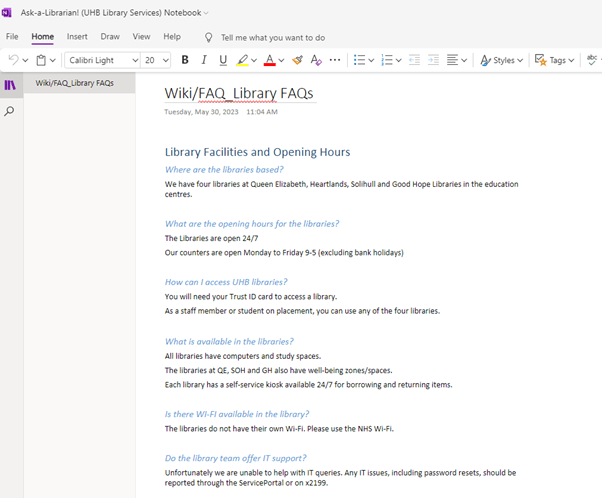
- Notebook to set-up a library FAQ/Wiki page
- A calendar to inform of upcoming training and other events
There is also a ‘Posts’ section where users can leave us questions and comments.
After the channel was initially set-up, we learnt about a ‘Power App’ called ‘Power Virtual Agents’ which allowed us to develop a 24/7 chatbot. The chatbot would be able to recognise a number of questions and provide a response based off answers we had stored into it. If it does not recognise a question, it would then link to contact details for the libraries. The chatbot also has the advantage of potentially being connected to our website so it can be used from there making it easily accessible. From the administration side, we would be able to see the questions asked and update the chatbot to reflect what our users are looking for.
As part of the process, we did some initially testing with our library team, particularly for the chatbot to ensure we have stored as many of the most common questions and answers as possible. We then also invited some of our users to join the channel and offer their feedback.
Due to maternity leave, the project was initially halted for around a year, but we are looking to launch the channel later in 2024 after a second user testing pilot to get more up-to-date feedback. We are also connecting with our IT department to investigate the advanced version of the chatbot so we can ensure it is running smoothly and make use of additional relevant features.
 Health Libraries Group